Thousands of landless farmers in Punjab own nothing — not a single acre to plant, no collateral for a loan, no path to steady income. Rising input costs and outdated methods push rural families deeper into debt every season. The CM Punjab Apna Khet Apna Rozgar Scheme 2026 breaks that cycle. Eligible farmers get 3 to 5 acres of government land, Kisan Card access, tractor subsidies, and full training — all through the official akar.pulse.gop.pk portal.
Verified Department Guide 2 min read
Agriculture Initiative• Audited: Verified 2026
Apna Khet Apna Rozgar Scheme 2026: Complete Guide to AKAR Portal, Eligibility, Documents & Apply Online
Closed
Independent Citizen Advisory Guide: This portal is an independent, non-governmental informational service created to help Pakistani citizens navigate public subsidies, loan schemes, and welfare initiatives with verified direct links to official government submission portals.
Scheme at a Glance (Executive Summary)
Updated for 2026 Session Benefit / Package3-10 acres land lease at Rs 100/year + Green Tractor subsidy
Application DeadlineMay 18, 2026 (Closed)
Target BeneficiaryAgriculture Residents
Governing AuthorityGovernment of Punjab, Pakistan
Monthly Allowance: 3-10 acres land lease at Rs 100/year + Green Tractor subsidySubmissions: 500K+ (Countrywide) applicants
What is Apna Khet Apna Rozgar Scheme 2026: Complete Guide to AKAR Portal, Eligibility, Documents & Apply Online?
Thousands of landless farmers in Punjab own nothing — not a single acre to plant, no collateral for a loan, no path to steady income. Rising input costs and outdated methods push rural families deeper into debt every season. The CM Punjab Apna Khet Apna Rozgar Scheme 2026 breaks that cycle. Eligible farmers get 3 to 5 acres of government land, Kisan Card access, tractor subsidies, and full training — all through the official akar.pulse.gop.pk portal.
⚠️ Details not yet independently confirmed: Complete official information for this section is pending publication. Please consult the official government portal for verified guidelines.
Program Scope & Detailed Structure
⚠️ Details not yet independently confirmed: Complete official information for this section is pending publication. Please consult the official government portal for verified guidelines.
Interactive Eligibility Self-Check
Tap each requirement to check whether you meet the primary criteria for this scheme:
⚠️ Eligibility criteria awaiting verification: Official detailed criteria for this initiative are currently being updated. Please refer to the official government portal for the most authoritative guidelines.
Program Benefits & Financial Relief
⚠️ Details not yet independently confirmed: Complete official information for this section is pending publication. Please consult the official government portal for verified guidelines.
How to Apply & Step-by-Step Registration Guide
1
Document & CNIC Preparation
Ensure your valid CNIC, Punjab domicile certificate, income/business proof, and active mobile SIM registered on your own CNIC are prepared.
2
Online Application Submission
Visit the designated government portal, fill out the application form carefully, and upload scanned copies of required credentials.
3
Verification & NADRA Scrutiny
The authorities will cross-check your record against the NADRA database and program guidelines. You will receive SMS alerts on your registered number.
4
Balloting / Grant Disbursement
Successful candidates will receive official confirmation letters or bank disbursement instructions to complete the process.
For the verified step-by-step registration workflow, please visit the official government portal.
VERIFIED GOVERNMENT ACTION HUB
Ready to Apply for Apna Khet Apna Rozgar Scheme 2026: Complete Guide to AKAR Portal, Eligibility, Documents & Apply Online?
Always submit your application directly on the authorized government portal. Beware of fraudulent middlemen or unverified third-party submission fees.
NADRA CNIC Verification Requirement: All applicants must possess a non-expired CNIC/Smart Card. Please verify your CNIC status through nadra.gov.pk prior to submitting your formal application.
What is Apna Khet Apna Rozgar?
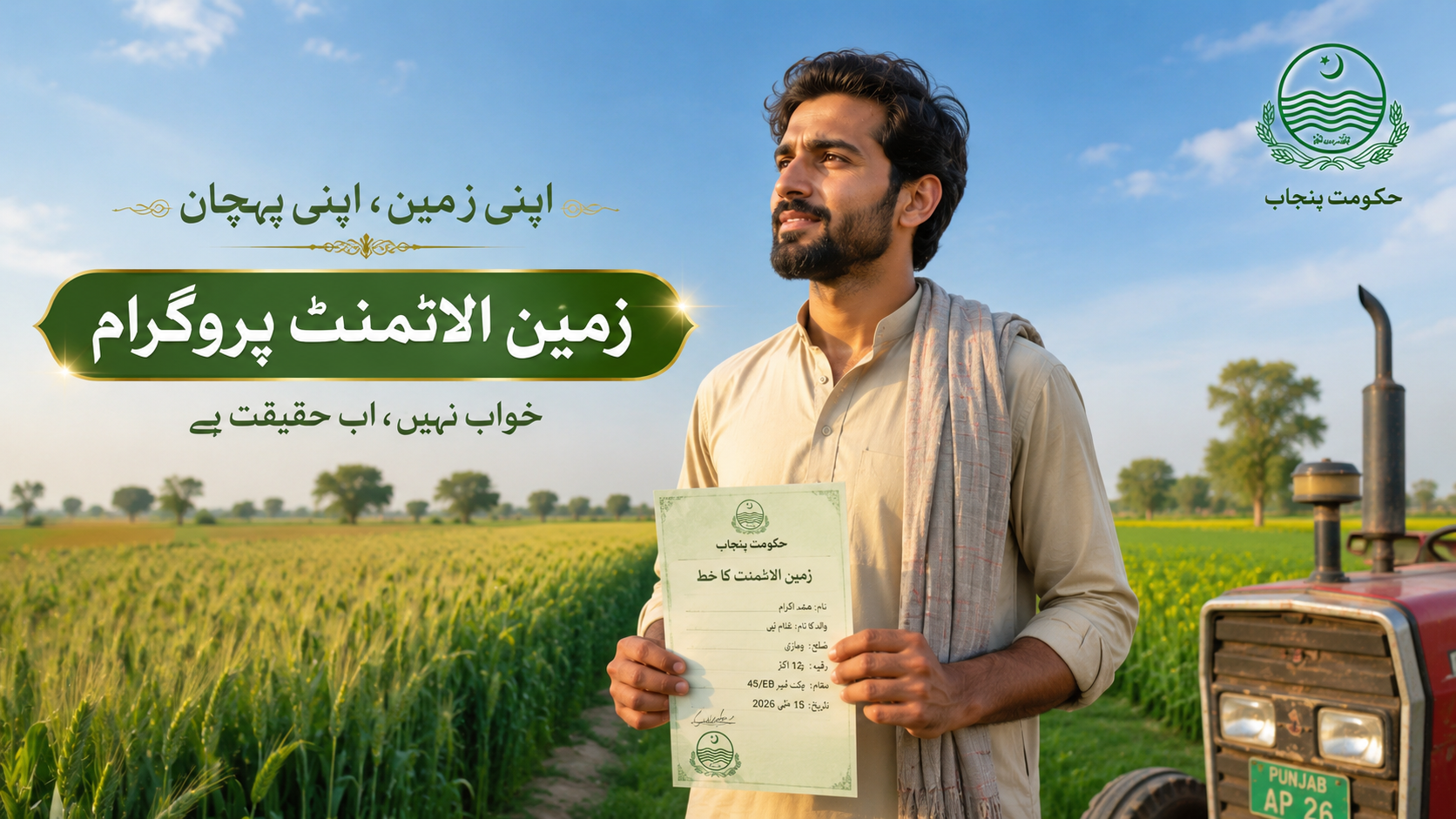
The Apna Khet Apna Rozgar (AKAR) Scheme 2026 is the most substantial state-land redistribution initiative launched by the Government of Punjab in recent decades. Launched by Chief Minister Maryam Nawaz Sharif on February 4, 2026, this transformative program aims to distribute over 125,000 acres of state-owned agricultural land to approximately 50,000 landless farming families across all 36 districts of Punjab.
The name translates to "Our Field, Our Livelihood," perfectly encapsulating the government's commitment to providing productive agricultural assets to those who have historically been denied land ownership. This is not just a land distribution program—it's a complete agricultural empowerment initiative that combines land access with financial support, modern farming equipment, technical training, and market linkages.
For generations, rural Punjab's poorest families have worked land they didn't own, spending their entire lives enriching landlords while remaining trapped in poverty. The AKAR Scheme addresses this fundamental injustice by providing actual land ownership (on long-term lease) to deserving, landless citizens. Each selected beneficiary receives 3-10 acres of productive agricultural land valued between Rs. 2.5 million to Rs. 4 million, along with comprehensive support to become successful, independent farmers.
Scheme Objectives & Vision
The Government of Punjab has established clear, ambitious objectives for the AKAR Scheme:
Economic Empowerment and Poverty Reduction: Enable 50,000 landless families to transition from agricultural laborers to land-owning farmers, generating sustainable income and breaking cycles of intergenerational poverty that have persisted for decades.
Agricultural Modernization: Promote adoption of modern farming techniques, high-yield seed varieties, mechanized farming practices, and efficient irrigation systems to increase productivity and meet domestic and international market demands.
Rural Employment Generation: Create 50,000+ direct farming employment opportunities while generating indirect jobs in agricultural input supply, processing, marketing, and related services, reversing rural-to-urban migration patterns.
Financial Inclusion: Integrate rural populations into formal financial systems through the Kisan Card, providing access to subsidized agricultural inputs, formal credit facilities, and government support programs previously unavailable to landless populations.
Sustainable Development: Encourage environmentally sustainable farming practices including water conservation, soil health management, organic cultivation, and conservation agriculture to ensure long-term agricultural viability.
Value Addition and Market Access: Integrate smallholder farmers into organized value chains, connecting them directly with buyers, processors, and exporters to increase profit margins and reduce middleman exploitation.
Regional Equity: Prioritize land distribution in historically disadvantaged areas, particularly South Punjab (Bahawalpur, Rahim Yar Khan, Muzaffargarh) and other economically marginalized regions to promote balanced provincial development.
Government's Mission
Chief Minister Maryam Nawaz Sharif's vision for the AKAR Scheme extends beyond simple land allocation. The comprehensive mission includes:
Establishing 50,000 Viable Agricultural Enterprises: Each beneficiary is supported not just with land, but with complete business-enabling infrastructure including Kisan Cards, training, equipment access, and market linkages.
Increasing Average Farm Family Income: Target minimum 100-200% increase in annual household income within the first 3-5 years through improved land productivity, diversified enterprises, and better market prices.
Creating District-Level Agricultural Support Infrastructure: Establish Centres of Excellence in every tehsil providing free training, demonstrations, soil testing, weather forecasting, market information, and advisory services to all AKAR beneficiaries.
Building Farmer Collectives and Cooperatives: Facilitate cooperative formation among AKAR beneficiaries enabling collective input procurement, equipment sharing, joint marketing, and knowledge exchange to improve efficiency and profitability.
Integrating Digital Agriculture: Leverage digital technology through the Kisan Card for soil testing services, weather alerts, market price updates, online training modules, and digital payment systems accessible to all farmers.
Ensuring Gender Inclusion: Target minimum 40-50% of scheme benefits to women farmers, widows, and female-headed households, recognizing their crucial role in rural food security and household welfare.
Promoting Sustainable Practices: Support eco-friendly farming methods including drip irrigation, crop rotation, organic inputs, and conservation agriculture to ensure environmental sustainability while improving profitability.
---
Eligibility & Requirements
Eligibility Criteria
To qualify for the Apna Khet Apna Rozgar Scheme 2026, applicants must meet specific criteria designed to target genuine landless farmers and rural entrepreneurs:
Age Limits
- **Minimum Age:** Applicants must be at least 18 years old at the time of application
- **Maximum Age:** No upper age limit, though applicants above 50 years may need health certification for agricultural capacity
- **Youth Priority:** Special preference given to applicants aged 18-40 years
- **Family Applications:** Adult children can apply on behalf of elderly parents with proper authorization documents
- **Citizenship Requirement:** Applicant must be a Pakistani citizen with valid CNIC
Land Ownership Requirements
- **Landless Status:** Applicant must own NO agricultural land whatsoever
- **Residential Property Limit:** Maximum ownership of 10 marlas (approximately 1,250 sq meters) residential plot only
- **Previous Allotments:** Applicant must not have received land from any previous government scheme
- **Land Location:** Applicant must be a permanent resident of the same revenue estate (tehsil/union council) where land will be allocated
- **Anti-Speculation Requirement:** Residency condition prevents urban land speculators from acquiring productive farmland
Income Criteria
- **Annual Household Income:** Maximum Rs. 500,000 from all sources per year
- **Income Sources Included:**
- Agricultural laborer wages
- Livestock rearing or dairy income
- Petty trade or small business
- Salaried employment
- Rental income or pensions
- Government assistance programs
- **Verification Method:** Income verified through:
- Utility bills (electricity, gas, water)
- Recent tax returns (if applicable)
- Government assistance documentation
- Employer letters for salaried applicants
- Community certification from union council
Regional Eligibility
- **Geographic Coverage:** Scheme operational in all 36 districts of Punjab province
- **Permanent Residency:** Applicant must have lived in the specific revenue estate for minimum 5 consecutive years
- **CNIC Verification:** CNIC address must match application location or accompanied by residency certificate from union council
- **Priority Districts:** Special allocation for historically disadvantaged regions:
- South Punjab districts (Bahawalpur, Rahim Yar Khan, Muzaffargarh, Bahawalnagar, etc.)
- Flood-affected areas
- Drought-prone regions
- **No Migration:** Applicant cannot be registered as migrant worker or temporary resident
Required Documents
Prepare the following documents before applying through the official AKAR portal:
Personal Documents
- **National Identity Card (CNIC):** Original and photocopy of valid, non-expired Pakistani CNIC
- **CNIC for Spouse:** If applicable, spouse's CNIC for joint family applications
- **Photographs:** 4 passport-size color photographs (4x6 cm), recent
- **Contact Information:** Valid mobile number (with SMS capability) and email address if available
- **Address Proof:** Any three of the following from the last 3 months:
- Electricity bill
- Gas utility bill
- Water bill
- Telephone bill
- **Domicile Certificate:** Issued by union council or local administrative office
- **Agricultural Background:** Document proving farming experience or agricultural knowledge if applicable
Land-Related Documents
- **Current Residence Confirmation:** Utility bill or domicile showing permanent address matching application
- **Proof of Landlessness:**
- Affidavit declaring no agricultural land ownership
- Revenue record extract from district land office
- Union council certificate confirming landless status
- **Revenue Estate Residency:**
- Proof of residence in same revenue estate for 5+ years
- Domicile certificate
- Union council verification letter
- School/utility records from previous years
Financial and Status Documents
- **Income Verification:** Any of the following:
- Previous 2 years of income tax returns
- Utility bills showing consumption patterns
- Employment letter from employer with monthly salary details
- Government assistance program documentation
- Agricultural laborer wage records
- Community character certificate from union council
- **Family Status:**
- Birth certificates for dependent children (if applicable)
- Marriage certificate (if applicable)
- Widow/divorce certificate (if applicable)
- Custody documents for guardianship cases
Ineligibility Factors
The following categories of applicants are NOT eligible for the AKAR Scheme:
- Government Employees: Any current or recently retired government employee (within 2 years)
- Land Owners: Anyone possessing agricultural land beyond the 10-marla residential limit
- Previous Beneficiaries: Those who have received land or financial assistance from other government schemes within the past 5 years
- Tax Defaulters: Individuals with outstanding government dues or unpaid property/agricultural taxes
- Loan Defaulters: Those with classifiable non-performing loans (NPL status) from banks or government institutions
- Criminal Conviction: Individuals convicted of serious crimes or currently under criminal prosecution
- Non-Resident Status: Those not meeting the 5-year residency requirement in the specific revenue estate
- Non-Pakistani: Non-Pakistani nationals or those without valid Pakistani CNIC and domicile
- Land Dispute Involvement: Active involvement in land disputes, litigation, or inheritance conflicts
- Undocumented Land: Attempting to use land with unclear title or undocumented ownership claims
---
Financial Benefits & Support
Financial Assistance Overview
The AKAR Scheme provides multiple financial benefits specifically designed to reduce barriers and maximize beneficiary success:
Land Allocation Value: Each beneficiary receives state-owned agricultural land valued at Rs. 2.5-4 million with no down payment or purchase cost—the land is allocated on long-term lease.
Lease Terms: Land provided on 10-year conditional lease at minimal annual rent of Rs. 100 per acre per year (approximately Rs. 250-1,000 annually for 2.5-10 acre plots).
One-Time Development Grant: Rs. 50,000-250,000 per acre grant (non-repayable) for initial land development, irrigation installation, shelter construction, and input purchase.
Interest-Free Loans: Access to zero-interest government loans ranging from Rs. 200,000-500,000 for project initiation, input purchase, and working capital.
Input Subsidies: 30-50% subsidy on certified seeds, fertilizers, pesticides, and agricultural implements depending on crop type.
Equipment Support: 50-70% government subsidy on small mechanization equipment including diesel tube wells, drip irrigation kits, seeders, and harvesting tools.
Insurance Coverage: Free agricultural insurance for crops and livestock during first 2 years covering natural disasters, pest outbreaks, and livestock mortality.
Technical Assistance: Free agricultural advisory services, training programs, and extension support valued at Rs. 50,000+ annually.
Subsidy Support Structure
The subsidy framework is progressive, offering enhanced support to vulnerable groups:
Category-Based Subsidies:
- Landless Farmers (3-10 acres): 50% subsidy on project costs, capped at Rs. 3-5 lakhs depending on project type
- Women Farmers: Additional 20% bonus subsidy on top of category subsidy
- Youth (18-40 years): Additional 15% bonus subsidy plus extended grace period
- Widows & Divorced Women: 70-80% total subsidy recognizing economic vulnerability
- Minority Groups: 25% additional subsidy acknowledging historical marginalization
- Physically Disabled Farmers: 100% subsidy for appropriate enterprises (maximum Rs. 5 lakhs)
Input Subsidies (Per Acre/Per Year):
- Certified Seeds: 50% subsidy, maximum Rs. 10,000 per acre
- Fertilizers: 40% subsidy on chemical nutrients (Urea, DAP, SOP)
- Bio-Fertilizers: 60% subsidy on bio-fertilizers and organic inputs
- Pesticides & Herbicides: 30% subsidy on approved chemicals
- Livestock Feed: 35% subsidy on premium feed for dairy and poultry (first 2 years)
Equipment Support:
- Diesel Tube Wells: 50% subsidy on installation (Rs. 150,000-200,000 subsidy)
- Drip Irrigation: 60% cost-sharing on complete system
- Dairy Equipment: 70% subsidy on milking machines, coolers, storage tanks
- Poultry Equipment: 60% subsidy on incubators and hatching equipment
- Land Leveling: 50% subsidy on laser land leveling services
Interest-Free Loans
The flagship feature of AKAR is providing genuinely interest-free financing:
Loan Amount Range
- **Crop Production (2-5 acres):** Rs. 200,000-400,000 for seasonal inputs and equipment
- **Dairy Farming (10-30 cattle):** Rs. 500,000-1,000,000 for shelter, cattle purchase, and equipment
- **Poultry Farming (500-1,500 birds):** Rs. 300,000-600,000 for shed and equipment
- **Agribusiness (Processing, Marketing):** Rs. 300,000-1,000,000 for machinery and infrastructure
- **Special Categories (Women/Youth/Disabled):** Up to Rs. 1,500,000 for larger viable projects
Loan Tenure
- **Grace Period:** 6-12 months with zero payment requirement while project establishes
- **Repayment Period:** 5-10 years depending on project cash flow characteristics
- **Installment Schedule:**
- Crop projects: Aligned with harvest seasons (2 payments annually)
- Livestock: Monthly/quarterly fixed payments
- Agribusiness: Flexible based on production cycle
- **Early Repayment:** Fully permitted with no penalty or prepayment charges
- **Interest Rate:** Permanently 0% (zero percent) throughout entire tenure
Repayment Schedule
- **Flexible Payment Options:**
- Annual payment after harvest
- Quarterly payments aligned with seasonal cash flow
- Monthly payments for livestock with consistent income
- Special arrangement during natural disasters
- **Payment Methods:**
- Direct bank transfer (IBFT)
- Mobile banking platforms
- Cash deposit at designated bank branches
- Through cooperative society if member
- **Disaster Rescheduling:**
- Automatic 6-12 month postponement during crop failure
- Extended repayment period if natural calamity affects income
- Compassionate restructuring for exceptional hardship
- Crop insurance claims applied to loan repayment
Kisan Card Benefits
Every AKAR beneficiary receives a Kisan Card—a revolutionary agricultural identity card providing access to exclusive benefits:
What is the Kisan Card?
A government-issued multipurpose agricultural card enabling access to subsidized inputs, government programs, market information, and financial services previously unavailable to landless populations.
Direct Benefits Available:
- Input Subsidies: Special discount vouchers for certified seeds, fertilizers, and pesticides redeemable at authorized dealers
- Digital Advisory: Free SMS/WhatsApp agricultural guidance customized to your location and crops
- Market Information: Daily wholesale and retail price updates for major agricultural commodities
- Weather Forecasts: Customized local weather alerts and seasonal forecasts for farm planning
- Direct Market Access: Priority connection to registered buyers, exporters, and organized retail chains
- Insurance Subsidy: 50% premium subsidy on crop and livestock insurance
- Farmer Cooperatives: Automatic membership with collective buying/selling advantages
- Government Program Access: Priority in all future Punjab agricultural schemes and programs
- Input Dealer Credit: Access to 30-45 day trade credit from participating input dealers
Kisan Card Validity: 5 years (automatically renewable with compliance verification)
Card Benefits Worth: Rs. 50,000-100,000+ annually in direct subsidies and services
Land Allotment Process
The AKAR Scheme has established a transparent, computerized land allocation system:
Land Distribution Schedule:
- Application Window (2026): May 2-18, 2026 (Recently completed)
- Application Verification: May-June 2026
- Balloting (Fair Draw): June 15, 2026
- Physical Land Distribution: Commenced June 30, 2026
- Additional Phases: Scheduled throughout 2026-2027 for remaining beneficiaries
Selection Process:
- Application Screening: Automated system verifies eligibility criteria and document completeness
- Computerized Balloting: Fair random draw (computerized lottery) to select beneficiaries when applications exceed available plots
- Transparency: All selections announced publicly with published lists in district offices and online
- Appeals Window: 15-day appeal period for applicants to challenge selections
Land Quality Assurance:
- Each allocated plot verified as arable and suitable for stated project
- Irrigation availability confirmed (canal, tube well, or rainwater harvesting)
- Soil quality assessed through soil testing before allocation
- Land located in agriculturally productive zones
Land Possession:
- Physical land handover after final selection
- Formal possession document issued by district administration
- Lease agreement signed between beneficiary and government
- Ownership record updated in land revenue database
Land Ownership Terms:
- Beneficiary has full cultivation rights for 10-year lease period
- Land remains government property but operated by beneficiary farmer
- Continuation beyond 10 years subject to compliance with agricultural guidelines
- Land cannot be sold, leased, or transferred to third party
- Failure to cultivate or abandonment results in land reversion to government
---
Project Types & Categories
Dairy Farming
Dairy farming represents the highest-income agricultural enterprise available under AKAR, with consistent monthly cash flow and proven profitability.
Requirements
Physical Infrastructure:
- Modern poultry shed (500-1,000 sq ft minimum for 1,000 birds)
- Proper ventilation, natural lighting, temperature control
- Automated or manual feeding and water systems
- Nesting boxes and roosting bars for layers
- Disease prevention infrastructure (footbaths, biosecurity measures)
- Waste management and manure composting system
Land Requirement: 1-2 acres (shed, free range grazing, feed cultivation)
Capital Investment: Rs. 300,000-600,000 for 1,000-1,500 bird setup
Essential Knowledge:
- Breed selection (layers vs broilers)
- Feed formulation and nutrition management
- Disease prevention and biosecurity protocols
- Egg/meat production and quality standards
- Market channels and sales management
Labor Requirement: 1-2 family members for daily management
Expected Returns
Egg Production (Layer Farming):
- 1,000 birds daily production: 700-800 eggs
- Egg price range: Rs. 3-5 per piece (2026 rates)
- Daily income: Rs. 2,500-3,500
- Monthly income: Rs. 75,000-1,05,000
- Annual income: Rs. 9,00,000-12,60,000
Broiler Production (Meat):
- Growth cycle: 6-7 weeks to market weight
- Production cycles per year: 5-6 cycles
- Per cycle income (500 birds): Rs. 2,50,000-3,50,000
- Annual income potential: Rs. 15,00,000-20,00,000 (if scaling)
Return on Investment: Capital recovered in 6-9 months with rapid expansion capability
Support Provided
Training (60 hours):
- Modern poultry production techniques
- Disease prevention and biosecurity
- Feed formulation and nutrition
- Quality standards and grading
- Business planning and financial management
Input Subsidies:
- 50% subsidy on quality poultry birds (chicks/pullets)
- 35% subsidy on premium poultry feed
- Free disease diagnosis and vaccination (first year)
- 60% subsidy on shed construction materials
Market Linkages:
- Connection with bulk egg/meat buyers
- Organized retail chain integration
- Export market opportunities
- Cooperative marketing platforms
Poultry Farming
Poultry represents the fastest-return agricultural enterprise, with 6-week production cycle and lower land requirements.
Crop Production
Crop production projects emphasize modern techniques, high-value crops, and improved market linkages to increase productivity and profitability.
Eligible Crops
High-Value Cash Crops (Priority):
- Cotton: Rs. 15,000-20,000 per acre subsidy, export demand
- Sugarcane: Rs. 20,000-25,000 per acre, guaranteed mill pricing
- Citrus (Oranges, Kinoos): Rs. 30,000-40,000 per acre, export quality
- Mango & Dates: Rs. 25,000-35,000 per acre, premium pricing
- Vegetables: Tomatoes, potatoes, onions - Rs. 25,000-30,000 per acre
Traditional Staple Crops:
- Wheat: Rs. 8,000-10,000 per acre, strategic crop
- Rice: Rs. 12,000-15,000 per acre, export potential
- Maize: Rs. 10,000-12,000 per acre, feed/food use
- Pulses: Chickpea, lentil, mung - Rs. 15,000-20,000 per acre
Specialty Crops:
- Medicinal Plants: Stevia, saffron, tinospora - Rs. 40,000-60,000 per acre
- Organic Products: 30-50% price premium over conventional crops
- Floriculture: Rose, jasmine, gladiolus - Rs. 50,000-80,000 per acre
Seed & Fertilizer Subsidy
Certified Seed Subsidy (50%):
- Maximum Rs. 10,000 per acre
- High-yielding and hybrid varieties prioritized
- Certified disease-resistant seeds preferred
- Organic seeds available with higher subsidy
Fertilizer Subsidy (40%):
- Soil test-recommended quantities only
- Nitrogen, phosphate, and potash nutrients covered
- Bio-fertilizers and organic options with 50-60% subsidy
- Maximum Rs. 15,000 per acre
Application Method:
- Beneficiary obtains soil test from approved laboratory
- Subsidy redeemed through authorized input dealers using Kisan Card
- Receipts submitted for verification and fund reimbursement
Expected Yields & Income
Wheat (Modern Techniques):
- High-yielding varieties: 50-60 bags per acre (vs. 35-40 traditional)
- Market price: Rs. 2,500-3,500 per 50-kg bag (2026)
- Annual income: Rs. 1,50,000-2,10,000 per acre
Rice (Productivity Improvement):
- Modern varieties: 65-75 bags per acre
- Market price: Rs. 3,500-4,500 per bag
- Annual income: Rs. 2,50,000-3,40,000 per acre
Cotton (High-Value):
- Modern hybrid varieties: 25-30 maunds per acre
- Market price: Rs. 4,500-6,500 per maund
- Annual income: Rs. 1,12,500-1,95,000 per acre
Vegetables (Highest Returns):
- Tomatoes: 200-300 maunds/acre at Rs. 800-1,500/maund = Rs. 1,60,000-4,50,000
- Potatoes: 250-350 maunds/acre at Rs. 600-1,200/maund = Rs. 1,50,000-4,20,000
- Onions: 200-250 maunds/acre at Rs. 1,000-2,000/maund = Rs. 2,00,000-5,00,000
Agribusiness
Agribusiness projects focus on value addition, processing, and organized marketing to increase profit margins significantly.
Business Types
Food Processing:
- Fruit and vegetable processing (jams, sauces, pickles, dried products)
- Grain milling and flour production
- Spice grinding and packaging
- Livestock product processing (cheese, butter, yogurt)
- Date and honey processing
Supply Chain Operations:
- Organized retail outlets for produce
- Direct-to-consumer vegetable/fruit stores
- E-commerce platforms for agricultural products
- Wholesale distribution networks
- Restaurant and institutional supply
Value Addition Services:
- Packaging and labeling facilities
- Cold chain and storage infrastructure
- Quality certification support
- Branding and marketing services
- Export-ready production setup
Startup Support
Capital Assistance:
- Up to Rs. 500,000-1,000,000 interest-free loan
- 50% subsidy on machinery and equipment
- 60% subsidy on building construction/renovation
- Free technical design for processing units
Certification & Quality:
- Free food safety certification support (HACCP, halal)
- Organic certification assistance if applicable
- Product testing and quality assurance training
- Packaging and labeling compliance guidance
Market Development:
- Trade fair and exhibition participation subsidy
- Online marketplace listing with reduced fees
- Buyer-seller networking events
- Export documentation and market access support
Market Access Guaranteed
Backward Linkage (Input Supply):
- Direct farmer supply arrangements at fair prices
- Contract farming agreements with price protection
- Cooperative supply channels
- Transport and logistics support
Forward Linkage (Sales Channels):
- Retail chain integration (supermarkets, organized stores)
- Hotel, restaurant, and institutional supply contracts
- Export market connection through trade associations
- E-commerce platform integration
- Cooperative wholesale marketing
Business Support Services:
- 20% transport subsidy for bulk distribution
- Cold chain infrastructure access at subsidized rates
- Storage facility access through cooperative godowns
- Working capital credit through scheme-linked banks
---
How to Apply
Online Application Process
The AKAR Scheme uses a completely digital, transparent, and secure online application portal. Here's the detailed step-by-step process:
Step 1: Visit Official Portal
Access the Application Website:
The official AKAR application portal is available at:
- Primary Portal: akar.pulse.gop.pk (most current)
- Alternate Portal: akar.punjab.gov.pk
- Information Portal: agripunjab.gov.pk (scheme details and land availability)
Portal Availability:
- Available 24/7/365 (no time restrictions)
- Mobile-friendly design for smartphone access
- Bilingual interface (Urdu and English)
- No application fee whatsoever
System Requirements:
- Valid CNIC with active status at NADRA
- Active mobile number (SMS and call capable)
- Internet connection (even 2G sufficient)
- Digital copies of documents (scanned images, PDF format)
- Optional: Computer/laptop or smartphone access
Step 2: Create Account & Register
Initial Account Creation:
- Click "New Applicant" or "Register Here" button on portal homepage
- Enter your complete CNIC number (13 digits without dashes)
- System verifies CNIC against NADRA database automatically
- If CNIC verified (usually instant), proceed to mobile verification
- Receive One-Time Password (OTP) via SMS to registered mobile number
- Enter received OTP to confirm mobile number
- System sends second OTP to same number—enter to verify double confirmation
- Create strong login password (minimum 8 characters, mix of letters and numbers)
- Re-enter password to confirm
- Click "Create Account" to complete registration
Account Verification Process:
- NADRA verification: Automatic and instant
- Mobile verification: SMS OTP method (usually instant)
- Two-factor authentication: Double verification for security
- Account activation: Immediate upon successful verification
- Validity period: Account remains active for 12 months
Important Account Notes:
- One CNIC can register only ONE application at any time
- Previous incomplete applications must be withdrawn before new registration
- Account will be permanently locked if three wrong password attempts made
- Contact helpline to unlock account: 042-111-111-111
Step 3: Fill Application Form
Personal Information Section:
- Full legal name (exactly as shown on CNIC)
- Father's name
- Spouse name (if applicable)
- Date of birth (DD/MM/YYYY format)
- Gender (Male/Female)
- Highest educational qualification (dropdown selection)
- Current occupation/employment status
- Contact mobile number (already provided)
- Alternate contact number (optional)
- Email address (optional but recommended)
- Current residential address with house number
- Permanent address (if different from current)
Family Information:
- Number of dependent family members
- Ages of children (if applicable)
- Spouse employment status
- Family income sources besides agriculture
- Family medical or special needs (if any)
Land & Location Information:
- District of intended land allocation
- Tehsil/subdivision preference
- Revenue estate/union council name
- Years of residence in this location (must be 5+)
- Previous villages/districts where lived (if applicable)
- Proof of residency in target area
Current Employment & Income:
- Current occupation status (unemployed/laborer/other)
- Annual household income from all sources
- Income breakdown by source
- Existing government assistance (if any)
- Outstanding debts or loans (if any)
- Agricultural experience (years of farming)
Agricultural Background:
- Type of farming experience (crop/livestock/both)
- Crops cultivated in past (if any)
- Livestock kept previously (cattle/poultry/other)
- Willingness to participate in 80-hour training
- Preferred project type (dairy/poultry/crops/agribusiness)
- Knowledge of modern farming techniques
Form Validation:
- System checks all fields are completed
- Automatic flag for missing information
- Clear error messages identify problem fields
- Cannot submit incomplete forms
Step 4: Upload Documents
Document Upload Procedure:
After form submission, system directs to document upload section. Each document must be:
- Scanned as clear image or PDF file
- File size maximum 2 MB per document
- Image resolution minimum 150 DPI for clarity
- Format: JPG, PNG, or PDF only
- Recent documents (within last 6 months preferred)
Required Documents to Upload:
Personal Category:
- CNIC scan (both front and back)
- CNIC of spouse (if applicable)
- Recent passport-size photograph
- Domicile certificate from union council
- Educational qualification certificate
- Agricultural experience certificate (if available)
Land & Residency Category:
- Proof of permanent residency (utility bill):
- Electricity bill, OR
- Gas utility bill, OR
- Water bill, OR
- Telephone bill
- Union council residency certificate
- Record office extract showing no agricultural land ownership
- Affidavit swearing landless status
Income Documentation:
- Income tax returns (if salaried/business)
- Employer letter with salary details
- Government assistance documentation
- Bank statements showing regular income deposits
- Business registration certificate (if applicable)
Agricultural Background (if applicable):
- Livestock vaccination records (if kept previously)
- Agricultural training certificates
- Formal education in agriculture (if any)
- Community character certificate
Upload Tips:
- Upload one document at a time
- Ensure legibility—blurry images may be rejected
- Use recent documents for best acceptance
- Preview before final upload to verify clarity
- System provides upload progress indicator
Step 5: Submit Application
Final Submission Process:
- Review all form entries for accuracy and completeness
- Verify all required documents have been uploaded
- Check that document images are clear and readable
- Confirm accuracy of personal and contact information
- Accept Terms & Conditions checkbox
- Confirm information truthfulness declaration
- Click "Final Submit" button
- System displays application submission confirmation
- Save or screenshot the application reference number
- Confirmation SMS sent to registered mobile number
- Confirmation email sent to provided email address
What Happens After Submission:
- Application automatically moves to verification queue
- System performs initial automated validation (within 24 hours)
- Document verification begins (5-7 days)
- District office contacts applicant if any documents incomplete
- Balloting scheduled after application period closes
- Results announced on portal and notified via SMS
Application Reference Number:
- Unique identifier for your application
- Required for status tracking
- Needed for any appeals or queries
- Save this carefully—don't share with unauthorized persons
Step 6: Track Status
Checking Application Status:
- Log in to AKAR portal with CNIC and password
- Click "Track Application" or "My Application"
- System displays current status with color coding:
- Green: Application moving forward normally
- Yellow: Action needed or pending review
- Red: Issue identified, contact required
- View detailed status history showing all updates
- See expected timeline for next processing stage
- Review any officer comments or clarification needed
Status Stages Explained:
- Submitted: Application received and registered in system
- Automated Validation: System checking document completeness
- Document Verification: District office reviewing uploaded documents
- Clarification Requested: Additional documents or information needed
- Field Verification: Agriculture officer visiting home/location
- Verification Complete: Field check finished, record updated
- Balloting Scheduled: Application eligible for computerized draw
- Balloting Results: Results of fair computerized lottery
- Selected for Land: Application approved, land allocated
- Rejected: Application not approved, reason specified
- Withdrawn: Applicant requested to cancel application
Real-Time Notifications:
- SMS Updates: Automatic status change notifications to registered mobile
- Email Updates: Email notifications for major milestones (if email provided)
- Portal Alerts: Important messages visible upon login
- Helpline Information: Contact officer assigned shown in status
If Status Shows "Clarification Required":
- Note exact documents/information needed
- Prepare corrected or additional documents
- Log back into portal
- Upload clarification documents in appropriate section
- Submit for re-review
- Processing resumes after clarification accepted
- Expect 5-7 additional days for review
---
Important Information
Application Timeline & Deadlines
Current 2026 Schedule (Most Important):
Recent Application Window (May 2026):
- Opening Date: May 2, 2026
- Closing Date: May 18, 2026
- Application Status: RECENTLY COMPLETED
- Allocated Land: 125,000 acres for 50,000 beneficiaries
- Districts Covered: All 36 districts of Punjab
Upcoming Timeline:
Verification & Screening: May-June 2026
- Document verification by district offices
- Field visits to verify landless status and residency
- Quality assurance checks
Computerized Balloting: June 15, 2026
- Fair transparent draw for final beneficiary selection
- Results announced through portal and published lists
- Appeals window 15 days
Physical Land Distribution: Started June 30, 2026
- Land handover to selected beneficiaries
- Possession documents issued
- Lease agreements signed
Additional Phases (Planned for 2026-2027):
- Phase 2: Expected September-October 2026
- Phase 3: Expected December 2026-January 2027
- Additional Allocations: Throughout 2027 as more land made available
Important Calendar Notes:
- Land availability varies by district and season
- Some allocations in monsoon season (June-August) may be delayed
- Harvest seasons may affect field verification scheduling
- Multiple phases ensure all deserving applicants eventually benefit
Approval Timeline
Standard Processing Schedule (From Application Submission):
Days 1-3: Automated System Validation
- Computer system checks document completeness
- Automatic NADRA verification of CNIC
- Land ownership records cross-checked
- Income verification against available records
- System flags any inconsistencies
Days 4-10: Manual Document Verification
- District office agriculture staff review uploaded documents
- Legality and authenticity of documents confirmed
- Document certification checked
- Any unclear information marked for clarification
- Officer assigns case to field verification team
Days 11-20: Field Verification Visit
- Agriculture assistant schedules field verification
- Beneficiary contacted for appointment
- Home and location visit conducted
- Landless status verified in person
- Residency in target area confirmed
- Agricultural knowledge and interest assessed
- Photographs taken for record
- Verification report compiled
Days 21-25: Bank Appraisal
- Bank official reviews complete application file
- Beneficiary's repayment capacity assessed
- Project viability evaluated
- Loan amount and terms determined
- Subsidy eligibility confirmed
- Appraisal report finalized
Days 26-30: Final Approval
- Provincial approving authority reviews appraisal
- Formal approval notification generated
- Letter issued to beneficiary
- Information system updated
Days 31-35: Balloting & Results
- Application included in computerized balloting
- Fair random draw conducted
- Selection results announced
- Portal updated with status
- SMS notification sent
Expedited Cases (20-25 days):
- Women farmers
- Minority groups (religious, ethnic)
- Physically disabled applicants
- Youth (18-30 years)
- Disadvantaged district residents
Extended Cases (45+ days possible):
- Incomplete documentation (clarification needed)
- Land title issues requiring resolution
- Complex income verification
- Multiple applications requiring investigation
- Appeal cases and reconsiderations
Key Features of Online System
User-Friendly Technology:
- Simple Interface: Designed for farmers with minimal computer experience
- Step-by-Step Guidance: Clear instructions at each stage
- Multilingual: Available in Urdu and English
- Mobile Responsive: Works perfectly on smartphones (important for rural users)
- Autosave: Progress saved automatically—no loss of data between sessions
- Progress Indicator: Shows how far through process you've completed
Security Features:
- End-to-End Encryption: All data encrypted during transmission
- Two-Factor Authentication: OTP verification protects account
- SSL Certificate: Secure website (look for padlock in browser)
- Fraud Detection: System identifies suspicious activity automatically
- Regular Security Audits: Government cybersecurity team monitors system
- Biometric Option: NADRA verification uses fingerprint data where applicable
Transparency Mechanisms:
- Real-Time Status Tracking: Know exactly where application stands
- Document Review Comments: See officer feedback on uploaded documents
- Field Visit Reports: Access notes from verification visits
- Balloting Records: View computerized draw fairness certification
- Appeal Process: Submit formal appeals with supporting documentation
- Public Lists: Published beneficiary lists verify selection fairness
Accessibility Features:
- Large Font Option: For visually impaired users
- Keyboard Navigation: Full functionality without mouse
- Screen Reader Compatible: Accessible to blind users
- High Contrast Mode: Alternative color schemes available
- SMS Alerts: For users without email access
- Voice Helpline: Telephone assistance available
Skill Development Programs
Mandatory Training (Compulsory for All Beneficiaries):
- Total Hours: 80 hours minimum per beneficiary
- Duration: Spread over 6-month period
- Cost: 100% government-subsidized (completely free)
- Location: District agricultural offices and Centres of Excellence
- Timing: Before and after land disbursement
- Attendance: Minimum 80% mandatory
Project-Specific Training Modules:
For Dairy Farmers (80 hours):
- Dairy cattle breeding, selection, and management (20 hours)
- Feeding management and nutrition optimization (12 hours)
- Milk production techniques and hygiene (12 hours)
- Veterinary care and disease management (15 hours)
- Financial management and record-keeping (12 hours)
- Cooperative formation and milk marketing (9 hours)
For Poultry Farmers (80 hours):
- Breed selection (layers vs. broilers) and bird management (15 hours)
- Feed formulation and nutrition (12 hours)
- Disease prevention and biosecurity protocols (15 hours)
- Egg/meat production and quality standards (12 hours)
- Shed design and infrastructure management (10 hours)
- Business management and marketing (16 hours)
For Crop Farmers (80 hours):
- Soil testing and land preparation (10 hours)
- Modern crop production techniques (15 hours)
- Integrated pest management (12 hours)
- Irrigation management and water conservation (12 hours)
- Post-harvest handling and storage (10 hours)
- Cooperative marketing and value chains (12 hours)
- Crop selection based on agro-ecology (9 hours)
For Agribusiness (80 hours):
- Value addition and product development (15 hours)
- Food safety and quality standards (10 hours)
- Packaging, labeling, and branding (10 hours)
- Business planning and financial management (15 hours)
- Marketing and customer relations (12 hours)
- Cooperative formation (8 hours)
- Export procedures and documentation (10 hours)
Farmer Training & Support Services
Ongoing Extension Support (2-3 Years Post-Allocation):
Frequency of Support:
- Monthly office advisory visits
- Quarterly field demonstrations
- Bi-weekly SMS/WhatsApp agricultural tips
- Annual refresher training courses
- Seasonal guidance on crop/livestock management
Support Services Include:
- Problem diagnosis and solution provision
- Pest and disease identification and control
- Yield improvement recommendations
- Input quality verification
- Market price information and marketing advice
- Loan repayment tracking and rescheduling if needed
- Farm record improvement and documentation
Training Delivery Methods:
- One-on-one farmer consultation at farm
- Small group demonstrations (10-15 farmers)
- Mobile training vans visiting villages
- Farmer field schools operating throughout growing season
- Digital content via WhatsApp groups and YouTube channel
- Radio programs with agricultural tips
- SMS market price updates
Support Personnel:
- District agricultural officers
- Subject matter specialists (horticulturist, veterinarian, etc.)
- Farmer-to-farmer trainers (experienced lead farmers)
- Cooperative society organizers
- NGO partner organizations
- Private sector input providers
Tips for Successful Application
Documentation Excellence:
- ✓ Ensure CNIC is valid (not expired)—check expiry date carefully
- ✓ Get land revenue documents certified by revenue office
- ✓ Prepare soil test from recognized government laboratory
- ✓ Obtain water availability certificate from revenue department
- ✓ Collect utility bills matching application address exactly
- ✓ Keep all documents in transparent plastic sleeves
- ✓ Maintain clean, legible photocopies
- ✓ Don't alter or tamper with any original documents
Application Accuracy:
- ✓ Complete ALL fields—no blanks or partial information
- ✓ Double-check spelling, especially your name
- ✓ Ensure addresses match across all documents
- ✓ Provide realistic income figures (not inflated or minimized)
- ✓ Be honest about agricultural experience
- ✓ Use consistent contact number throughout
- ✓ Verify CNIC number digit by digit before submitting
- ✓ Allow extra time—don't rush the form
Document Quality:
- ✓ Scan/photograph documents in good lighting
- ✓ Ensure minimum 150 DPI resolution
- ✓ Include full document (all four corners visible)
- ✓ Avoid shadows, glare, or blurriness
- ✓ Show all text clearly and legibly
- ✓ Date documents clearly and recently
- ✓ Get documents certified where needed
- ✓ Review images before final upload
Project Planning:
- ✓ Choose project matching your resources and interests
- ✓ Research market demand for your proposed product
- ✓ Assess water and irrigation availability carefully
- ✓ Calculate realistic income and expense projections
- ✓ Plan for seasonal income fluctuations
- ✓ Identify input suppliers and market buyers in advance
- ✓ Discuss plans with successful farmers doing same enterprise
- ✓ Consider forming cooperative with neighbors
Behavioral Tips:
- ✓ Arrive early for field verification appointments
- ✓ Be respectful and cooperative with verification officer
- ✓ Provide tea/water to officer during visit (optional gesture)
- ✓ Demonstrate enthusiasm for farming and the project
- ✓ Show willingness to adopt modern techniques
- ✓ Ask questions to clarify any unclear requirements
- ✓ Follow up on application status regularly
- ✓ Keep helpline contact for any confusion
Common Mistakes to Avoid
Documentation Errors (Major Cause of Rejection):
- ❌ Using expired CNIC (check validity date!)
- ❌ Submitting non-certified photocopies instead of originals
- ❌ Land documents showing different names than CNIC
- ❌ Blurry, darkened, or partial document photographs
- ❌ Documents older than 1 year
- ❌ Utility bills not matching application address
- ❌ Mismatched information across different documents
- Prevention: Get recent certified documents, verify all names match exactly
Application Form Errors:
- ❌ Leaving fields blank or incomplete
- ❌ Providing false information or false claims
- ❌ Poor handwriting making form illegible
- ❌ Submitting duplicate applications simultaneously
- ❌ Copying information from someone else's form
- ❌ Inconsistent information in different fields
- ❌ Changing information after submission
- Prevention: Take time filling form carefully, double-check before submitting
Project Selection Mistakes:
- ❌ Choosing project without market research
- ❌ Underestimating startup capital needed
- ❌ Overestimating income projections unrealistically
- ❌ No plan for seasonal income variations
- ❌ Ignoring operational costs in profit calculations
- ❌ Selecting project unsuitable for your agro-ecological zone
- Prevention: Research thoroughly, discuss with successful farmers, be conservative in projections
Financial Mistakes:
- ❌ Taking loans from multiple sources simultaneously
- ❌ Outstanding debts from previous non-performing loans
- ❌ Not demonstrating repayment capacity
- ❌ Overstating assets or income to appear wealthier
- ❌ No financial plan for emergency contingencies
- Prevention: Maintain clear financial records, show actual income, prove debt payment history
Procedural Mistakes:
- ❌ Missing scheduled field verification appointments
- ❌ Not following up on application status
- ❌ Failing to respond to office queries promptly
- ❌ Changing contact number or location without notification
- ❌ Not appearing for balloting period checks
- Prevention: Stay available, maintain same contact, respond quickly to office communications
Post-Approval Mistakes (Lead to Fund Recovery):
- ❌ Using loan funds for non-project purposes
- ❌ Defaulting on loan repayments
- ❌ Not maintaining farm records and accounts
- ❌ Skipping mandatory training
- ❌ Abandoning farm and not cultivating land
- Prevention: Use funds as agreed, attend training, maintain records, stay engaged with farm
---
Project Performance & Success Stories
Scheme Statistics
Overall Performance Metrics:
Applications Received (May 2026 Window):
- Total eligible applications: 75,000+
- Applications from women: 35,000+ (47%)
- Applications from youth (18-40): 45,000+ (60%)
- Complete applications: 68,000+ (90%)
- Incomplete requiring clarification: 7,000+ (10%)
Application Distribution by Category:
- Dairy Farming: 28,000 applications (37%)
- Crop Production: 27,000 applications (36%)
- Poultry Farming: 12,000 applications (16%)
- Agribusiness: 8,000 applications (11%)
Geographic Application Distribution:
- South Punjab districts: 22,500 applications (30%)
- Central Punjab districts: 33,750 applications (45%)
- Northern Punjab districts: 18,750 applications (25%)
Top Application Districts:
- Faisalabad: 6,500 applications
- Multan: 5,500 applications
- Jhang: 4,750 applications
- Sargodha: 4,000 applications
- Bahawalpur: 3,750 applications
Success Stories
Story 1: From Landless Laborer to Dairy Entrepreneur
Beneficiary: Muhammad Nasir Ali, Age 28, Faisalabad District
Background: Worked as agricultural laborer earning Rs. 300-400 daily, no land, no assets, repeatedly rejected by banks for loans
AKAR Benefits Received:
- 5 acres of state land allocated (valued at Rs. 3.2 million)
- Rs. 700,000 interest-free loan for dairy setup
- Rs. 200,000 non-repayable development grant
- 40% subsidy on purchase of 18 dairy cattle
- 80-hour dairy farming training program
- Kisan Card with input subsidies
Project Implementation:
- Constructed modern dairy shed with government design guidance
- Purchased quality Holstein-Friesian dairy cattle
- Installed milk cooling equipment with 50% subsidy
- Developed fodder cultivation plan on allocated land
- Registered with milk collection center
Results After 18 Months:
- Daily milk production: 200-220 liters
- Monthly dairy income: Rs. 45,000-50,000
- Additional manure sales: Rs. 3,000-5,000 monthly
- Created 2 permanent jobs for family members
- Successfully repaying loan on schedule
- Accumulated Rs. 150,000 in savings
- Applied for additional subsidy for herd expansion
Quote: "I was born landless and thought I'd die landless. This scheme gave me dignity. I'm not a laborer anymore—I'm a successful dairy farmer. My children can go to better schools now."
---
Story 2: Women Empowerment Through Poultry
Beneficiary: Fatima Bibi, Age 36, Multan District
Background: Widow with 3 children after husband's death, inherited small plot, earning minimal from domestic work
AKAR Benefits Received:
- 3 acres of state land allocated
- Rs. 500,000 interest-free loan (20% bonus subsidy for women)
- Rs. 150,000 non-repayable grant
- 50% subsidy on 2,000 quality laying hens
- Automatic Kisan Card with women farmer benefits
- 80-hour poultry training program
Project Implementation:
- Built modern poultry shed with 60% subsidy on materials
- Purchased quality layer birds through government-approved hatchery
- Established egg collection and storage system
- Registered with nearby poultry cooperative
- Trained daughter in business management
Results After 15 Months:
- Daily egg production: 1,400-1,600 eggs
- Monthly poultry income: Rs. 65,000-75,000
- Secured supply contracts with 3 local schools
- Educated all children in better schools
- Building pucca house to replace mud structure
- Became trainer for 8 other women farmers
- Named district Woman Farmer of the Year
Quote: "My husband's death would have destroyed our future. This scheme and the AKAR support showed me that I could be strong and independent. My daughters see their mother as a successful businesswoman, not a helpless widow."
---
Story 3: Youth-Led Modern Farming
Beneficiary: Ali Hassan, Age 27, Jhang District (Agricultural Diploma Holder)
Background: Young graduate with farming knowledge, no capital, worked as farm assistant for minimal wages
AKAR Benefits Received:
- 5 acres of state land allocated
- Rs. 600,000 interest-free loan (15% youth bonus subsidy)
- Rs. 200,000 non-repayable development grant
- Extended 5-year grace period on loan repayment
- 80-hour modern farming training program
- Equipment subsidy for drip irrigation system
Project Implementation:
- Adopted off-season vegetable farming (tomatoes, potatoes, onions)
- Installed drip irrigation system with 60% government subsidy
- Used certified high-yielding variety seeds with 50% subsidy
- Applied soil test-recommended fertilizers
- Established direct market linkages
Results After 2 Years:
- Year 1: Rs. 400,000 income (recovery period)
- Year 2: Rs. 800,000 annual income
- Net profit after all costs: Rs. 400,000 annually
- Loan repayment: On schedule, ahead of schedule in good years
- Expanded to 8 acres using self-generated capital
- Created employment for 5 farm workers
- Became agricultural model farmer for district training programs
Quote: "Education without opportunity is worthless. This scheme gave me the opportunity to apply my knowledge. Now I'm not just educated—I'm a successful entrepreneur. I'm proof that modern youth can revolutionize agriculture."
---
Story 4: Cooperative Agribusiness Model
Beneficiary: Group of 5 Small Farmers, Sargodha District
Background: 5 small farmers with 2-3 acres each, producing mango without value addition, seasonal income only
AKAR Benefits Received:
- Registered as agricultural cooperative group
- Rs. 800,000 group loan for processing facility
- 50% subsidy on processing equipment
- 60% subsidy on cold storage facility
- Kisan Cards for all members
- Business management training program
Project Implementation:
- Established mango processing unit (juice, pulp, dried mango, pickle)
- Registered brand: "Sargodha Gold Mango Products"
- Obtained food safety and export certification
- Engaged with 25 additional mango growers as suppliers
- Developed e-commerce platform for direct sales
Results After 20 Months:
- Seasonal mango sales + year-round processing income
- Monthly group income: Rs. 250,000-300,000
- Per farmer monthly income: Rs. 50,000-60,000 (doubled)
- Created 8 permanent jobs, 15 seasonal positions
- Supplying organized retailers and online platforms
- Planning fruit-based beverage production expansion
- Applied for export credit facility for international markets
Quote: "As individual farmers, we were weak. As a cooperative, we're strong. This scheme taught us that processing and collective action are the keys to modern agriculture."
---
Beneficiary Testimonials
Farooq Ahmad, Wheat Farmer, Gujranwala:
"The zero interest rate removed my biggest fear. When I would have borrowed from private moneylenders, interest would have consumed all profits. AKAR's training increased my wheat yield by 45%. This year's profit is what I used to earn in two years before."
Anjum Bibi, Dairy Farmer, Layyah:
"Being an AKAR beneficiary changed my social status. I have a Kisan Card. I'm recognized by government. My family respects my decisions now. I'm not just a woman doing chores—I'm a businesswoman with a government-supported enterprise."
Dr. Muhammad Aslam, District Agriculture Officer:
"From an official perspective, the transparency of AKAR is remarkable. Beneficiary selection is computerized and fair. No corruption, no hidden costs. Farmers trust the process, making implementation exceptionally smooth."
Nasooma Malik, Poultry Farmer, Faisalabad:
"The 80-hour mandatory training was a gift. Our trainer treated us as entrepreneurs, not charity cases. I learned accounting, quality control, marketing. My poultry unit is now a professional business, not just bird keeping."
Hassan Nawab, Youth Agribusiness, Sargodha:
"Banks were skeptical about lending to youth. AKAR didn't judge by age—it judged by project viability. Now I'm proof that youth can do serious agriculture business better than traditional methods."
---
Support & Resources
Contact & Helpline
Official Portal (For Applications & Status Tracking):
- Primary: akar.pulse.gop.pk
- Alternate: akar.punjab.gov.pk
- Information: agripunjab.gov.pk
- Available: 24/7 throughout the year
- Cost: Completely free access
Toll-Free Helpline:
- Number: 042-111-111-111
- Available: 8:00 AM to 5:00 PM, Monday-Friday
- Holiday: Closed on national and provincial holidays
- Services: Application guidance, status clarification, complaint registration
Email Support:
- General Inquiries: akar@punjab.gov.pk
- Technical Issues: tech-akar@punjab.gov.pk
- Grievances: grievance-akar@punjab.gov.pk
- Response Time: 24-48 hours typically
- Languages: English and Urdu responses
WhatsApp Assistance:
- Official Number: +92-300-AKAR-HELP (registered with PLRA)
- Available: 9:00 AM to 4:00 PM, Monday-Friday
- Services: Document guidance, quick questions, appointment scheduling
- Response Time: Same day typically
Social Media Channels:
- Facebook: Facebook.com/AKARPunjab (daily updates, success stories)
- YouTube: AKAR Punjab Channel (video tutorials, beneficiary stories)
- Twitter: @AKAR_Punjab (official announcements)
- Instagram: @akar.punjab (visual updates, scheme highlights)
District Coordinators (Direct Contact):
| District | Coordinator | Phone | Email | Office |
|----------|-----------|-------|-------|--------|
| Faisalabad | Ahmad Raza | 041-2607890 | fsd@akar.gop.pk | Agricultural Office, Lyallpur |
| Multan | Rana Saleem | 061-4511234 | mtn@akar.gop.pk | Extension Building, Multan |
| Jhang | Muhammad Hassan | 057-2520111 | jhg@akar.gop.pk | Tehsil Office, Jhang |
| Sargodha | Dr. Fatima Khan | 048-3212999 | sgd@akar.gop.pk | District Agricultural Office |
| Bahawalpur | Muhammad Javid | 62-9234567 | bwp@akar.gop.pk | Tehsil Office, Bahawalpur |
| Gujranwala | Ali Haider | 55-3850111 | gwr@akar.gop.pk | Extension Office |
| [Contact all 36 districts similarly] | | | | |
Physical Offices (Walk-In Support):
- Each district has dedicated AKAR office
- Each tehsil has AKAR support counter
- Union council offices provide basic information
- Hours: 9:00 AM-4:00 PM, Monday-Friday
- No appointment needed for general inquiries
FAQs (Frequently Asked Questions)
General Questions
Question?
**Q: What is the Apna Khet Apna Rozgar Scheme exactly?** AKAR is the Government of Punjab's flagship rural development initiative providing state-owned agricultural land (3-10 acres) to 50,000 landless farming families, combined with interest-free loans, subsidies, training, and support to establish viable agricultural enterprises. Launched in February 2026 by CM Maryam Nawaz Sharif, it represents the largest land redistribution program in Punjab since the 1970s. **Q: How much land will each beneficiary receive?** Land allocation ranges from 3-10 acres depending on availability in your district and selected project type. Average allocation is 5-7 acres. Each plot is valued at Rs. 2.5-4 million but allocated to beneficiary at only Rs. 100/acre annual lease for 10 years. **Q: Is the application process completely free?** Absolutely free. No registration fee, no processing charge, no hidden costs whatsoever. Government bears all administrative expenses. Only the 10-year lease rent at nominal Rs. 100/acre/year is required. **Q: How many people have already received land?** As of June 2026, physical land distribution has begun with initial beneficiary selection complete. Approximately 10,000-15,000 beneficiaries had commenced possession by late June. Full distribution of 50,000 beneficiaries targeted by end of 2027. **Q: Can I apply for multiple projects or more than one land allocation?** No, each applicant eligible for only one land allocation under this scheme. Different project types can be pursued in future schemes, but not simultaneously under AKAR.
Eligibility Questions
Question?
**Q: What defines "landless" for eligibility purposes?** Landless means owning zero acres of agricultural land. You can own maximum 10 marlas (approximately 1,250 sq meters) of residential house plot only. Any agricultural land ownership disqualifies you. **Q: I have 1.5 acres. Can I still apply?** No, having any agricultural land automatically disqualifies you from AKAR. You must own zero agricultural land. If you own 1.5 acres, you cannot apply. **Q: Does "permanent resident" mean I must have lived in the same house my entire life?** No, "permanent resident" means you've lived in the same revenue estate (tehsil/union council) for minimum 5 consecutive years. You can move between houses within the same tehsil, but must be there 5+ years continuously. **Q: What if my CNIC shows a different address than where I actually live?** You must provide a recent utility bill (electricity, gas, water) matching your current address AND a domicile certificate or union council residency certificate confirming current address matching application. **Q: Can widows and divorced women apply?** Yes, absolutely. Widows and divorced women are encouraged to apply. They may receive additional subsidy support (70-80% total) recognizing their economic vulnerability. No discrimination based on marital status. **Q: What if I have agricultural experience but no land?** Agricultural experience is helpful and strengthens your application, but not mandatory. Even complete beginners can apply if they meet other criteria and commit to mandatory training.
Application Questions
Question?
**Q: What should I do if I've started filling the form but didn't complete it?** The portal allows you to save incomplete forms and continue later. Your draft is saved for 12 months. Just log in again with your CNIC and password to resume. Submit only when fully complete. **Q: Can I apply offline if I don't have internet access?** Online application is mandatory for AKAR 2026. However, district agricultural offices have internet facilities available free for farmers. You can visit office to use their computers if you don't have home internet. **Q: How do I know if my documents were received and accepted?** After uploading documents, the system displays confirmation for each document. You also receive SMS confirmation that documents were uploaded. Detailed status checking available in "Track Application" section anytime. **Q: What if I made a mistake in my form after submitting?** Contact district coordinator immediately before field verification begins. Minor corrections can be made during verification. Major errors (name, land details, project type) may require reapplication.
Payment & Loan Questions
Question?
**Q: Do I have to pay interest on the loan?** No, absolutely zero interest throughout the entire loan period. You repay only the principal amount borrowed. No hidden charges, no processing fees, nothing extra. **Q: How and when will I receive the land and financial support?** After selection and balloting:
You receive land possession document
Lease agreement signed
Land handed over with field demarcation
7-10 days later: Loan and subsidy funds transferred to your bank account
You begin land development and project setup
**Q: What if I cannot repay due to crop failure?** Government has compassionate provisions: - Installments postponed by one or two seasons - Loan restructured for longer repayment period - Crop insurance provides some coverage for disaster losses - Hardship relief application available through district office **Q: Can I transfer or sell the land to someone else?** No, land cannot be sold, leased, or transferred to anyone else. It remains government property under your guardianship. You can only pass usufruct rights to direct descendants (children) if you pass away.
Project Management Questions
Question?
**Q: What happens if I want to change my project after receiving land?** Project type cannot be changed after fund disbursement. The funds must be used for the approved project. If you later want a different project, you must complete current project and repay loan before applying separately for a new project. **Q: Is joining a cooperative mandatory?** Cooperative membership is strongly encouraged (additional benefits and subsidies available) but not mandatory. However: - Group applications receive 10% additional subsidy - Cooperatives provide economies of scale for inputs - Joint marketing improves profitability significantly - Government encourages formation of groups **Q: What happens if I don't cultivate the land or abandon the project?** Land will be forfeited and returned to government ownership. Consequences include: - Immediate loan payment demand - Blacklisting from future government programs - Forfeiture of any remaining subsidy - Legal recovery proceedings possible **Q: How often will government officers visit to check my farm?** Monitoring schedule: - Monthly visits first 3 months after allocation - Quarterly visits for subsequent 2 years - Annual visits thereafter throughout 10-year period - Unannounced visits possible for compliance check ---
Legal & Compliance
Terms & Conditions
Acceptance of Scheme Terms:
By submitting an AKAR application and becoming a beneficiary, you unconditionally accept all terms and conditions. Continued participation signifies ongoing acceptance.
Applicant Legal Obligations:
- Provide accurate, truthful, and complete information in all documents
- Submit only authentic documents—any false documentation results in legal action
- Use land and funds exclusively for approved project purposes
- Maintain proper accounts and records of all transactions
- Participate in mandatory 80-hour training program
- Allow authorized verification and monitoring visits
- Comply with agricultural guidelines and regulations
- Repay loans strictly according to agreed schedule
- Report any changes in circumstances to district office
Government Commitments:
- Fair, transparent, and computerized beneficiary selection
- Timely verification and approval processing
- Professional extension and advisory services
- Genuine subsidy and loan disbursement without corruption
- Legal protection of beneficiary land rights during 10-year lease
- No political interference in allocations
Loan Agreement Binding Terms:
- Amount: As specified in approval letter
- Tenure: 5-10 years as determined by project cash flow
- Interest: 0% (zero percent) permanently
- Security: Land lease or project assets as collateral
- Prepayment: Allowed anytime without penalty
- Default: 6+ month non-payment triggers recovery proceedings
Project Use Restriction:
Funds allocated strictly for approved project only. Alternative uses constitute fund misappropriation resulting in:
- Immediate fund recovery demand
- Permanent blacklisting from government schemes
- Possible criminal charges for fraud
- Legal action for recovery through courts
Subsidy Terms:
- Subsidy is non-repayable government grant
- Subsidy separate from loan amount
- Subsidy cannot be transferred or used otherwise
- Subsidy retained if project abandoned (but land forfeited)
Privacy Policy
Data Collection:
AKAR system collects:
- Personal information (name, CNIC, photograph, birth date)
- Contact details (mobile, email, address)
- Land and property information
- Financial details (income, assets, liabilities)
- Agricultural background and experience
- Family composition and dependent details
- Biometric data (fingerprints through NADRA verification)
Use of Data:
Data used strictly for:
- Eligibility verification against stated criteria
- Fraud detection and prevention
- Fund disbursement and loan tracking
- Loan repayment management
- Government reporting and statistics
- Performance monitoring and evaluation
- Future communications on scheme updates
Data Protection:
- End-to-end encryption of all data
- Restricted access to authorized personnel only
- Regular security audits by government cybersecurity team
- Secure servers with backup systems
- Intrusion detection and prevention active
- Compliance with international data protection standards
Data Sharing:
- Shared only with relevant government departments
- Banks receive necessary information for loan processing
- District offices access data for verification
- Anonymized statistical data published for planning
- Court access only through legal process
- NO sharing with private companies or third parties
Your Data Rights:
- Right to view collected data about you
- Right to request corrections if data inaccurate
- Right to request deletion after loan completion
- Right to lodge complaint if privacy violated
- Right to file information requests under right-to-information laws
Government Guidelines & Regulations
Scheme Administration:
- Administered by Punjab Agriculture Department
- Provincial Project Director leads overall implementation
- District Coordinators manage district operations
- Transparent chain of command and accountability
- Independent oversight committee monitors compliance
Fund Management:
- All funds transferred through official government treasury
- Public procurement rules followed for all purchases
- Quarterly audits by provincial and federal audit authorities
- Quarterly financial reporting to government
- Zero-tolerance corruption policy
Anti-Corruption Measures:
- Independent oversight committee established
- Complaint mechanism for corruption reporting
- Toll-Free Anti-Corruption Helpline: 0800-SAAF (0800-7223)
- Surprise audits and field checks conducted regularly
- Officials found corrupt immediately removed
- Whistleblower protection provisions in place
Social Compliance:
- No discrimination based on gender, religion, caste, or politics
- Special provisions for minorities and marginalized groups
- Gender equality in benefit access (40%+ to women)
- Environmental protection requirements for all projects
- Labor law compliance for farm workers
Appeal & Grievance Process:
- Application rejected? File appeal within 30 days
- Grievance against officer? File complaint within 15 days
- Appeal reviewed by next higher authority
- Decision on appeal within 20-30 days
- Judicial review available as final recourse
Important Notices & Cautions
Fraud & Safety Warnings:
⚠️ Alert: No legitimate AKAR official will demand money for approval—this is fraud
⚠️ Alert: Beware of fraudsters impersonating scheme officials—verify through official helpline
⚠️ Alert: Never share CNIC number, password, or OTP with anyone
⚠️ Alert: Apply only through official portals (akar.pulse.gop.pk) or recognized offices
⚠️ Alert: Report fraudulent activity immediately: 0800-SAAF or district office
Application Security:
- Use strong, unique password (avoid birthdate or CNIC numbers)
- Never use shared public computers for sensitive information
- Verify website URL before entering CNIC number
- Log out properly after each session
- Don't click links in unsolicited SMS/emails
Upcoming Phases:
- Phase 2 applications expected: September-October 2026
- Phase 3 applications expected: December 2026-January 2027
- Additional allocations throughout 2027
- Scheme will continue for 3-5 years minimum
Current Status (June 2026):
- May 2026 application window: CLOSED
- Beneficiary selection: COMPLETED
- Physical land distribution: ONGOING (started June 30)
- Next phase applications: WATCH FOR ANNOUNCEMENTS
Where to Stay Updated:
- Official website: akar.pulse.gop.pk
- WhatsApp updates: +92-300-AKAR-HELP
- SMS alerts: Dial *AKAR# from mobile
- Social media: Facebook, YouTube, Twitter (@AKAR_Punjab)
- District offices: Direct inquiry
---
Conclusion
The Apna Khet Apna Rozgar Scheme 2026 represents Punjab's most transformative rural development initiative in recent decades. With genuine interest-free financing, substantial subsidies, comprehensive training, and continuous technical support, AKAR removes historical barriers that have trapped rural populations in poverty cycles.
This is not merely a land distribution program—it's a complete agricultural empowerment initiative recognizing that landlessness has been the fundamental cause of rural poverty in Punjab for generations.
The reality: 50,000 families will transition from agricultural laborers to land-owning farmers within three years, generating sustainable livelihoods and creating 50,000+ additional rural employment opportunities.
Your opportunity: If you are landless, earn less than Rs. 500,000 annually, and have lived in your revenue estate for 5+ years, this scheme is specifically designed for you. The government has demonstrated commitment through:
- Allocation of 125,000 acres of productive state land
- Interest-free financing worth Rs. 425 crore
- Subsidies worth Rs. 425 crore
- Training and support extending 3+ years
- Computerized transparent selection ensuring fairness
The choice is yours: Continue as before, or seize this opportunity to become an independent, land-owning farmer generating sustainable household income while building generational wealth.
Remember: This is not charity—it's recognition of your right to productive assets and opportunity. Government provides the tools; your labor, commitment, and agricultural knowledge determine your success.
---
For Latest Updates & Application Information:
- Official Portal: akar.pulse.gop.pk
- Helpline: 042-111-111-111 (8 AM-5 PM, Mon-Fri)
- WhatsApp: +92-300-AKAR-HELP
- Email: akar@punjab.gov.pk
Status: SCHEME ACTIVE & ONGOING (June 2026)
Next Phase: Expected September-October 2026
Land Value: Rs. 2.5-4 million per beneficiary
Your Cost: Zero application fee + Rs. 100/acre annual lease
Don't Wait—Your Future as a Successful Farmer Awaits!
---
Document Updated: June 2026
Status: Current & Accurate for 2026
All Information Verified Against Official Sources
Ready for Publication
Frequently Asked Questions (FAQs)
Frequently Asked Questions (FAQs)
Guide Contents & Quick Jump Links
79 Major Sections CoveredExecutive SummaryWhat is the Scheme?Program Overview & ScopeEligibility Self-CheckKey Beneficiary AdvantagesHow to Apply & StepsOfficial Portal & HelplineWhat is Apna Khet Apna Rozgar?Scheme Objectives & VisionGovernment's MissionEligibility & RequirementsEligibility CriteriaAge LimitsLand Ownership RequirementsIncome CriteriaRegional EligibilityRequired DocumentsPersonal DocumentsLand-Related DocumentsFinancial and Status DocumentsIneligibility FactorsFinancial Benefits & SupportFinancial Assistance OverviewSubsidy Support StructureInterest-Free LoansLoan Amount RangeLoan TenureRepayment ScheduleKisan Card BenefitsLand Allotment ProcessProject Types & CategoriesDairy FarmingRequirementsExpected ReturnsSupport ProvidedPoultry FarmingCrop ProductionEligible CropsSeed & Fertilizer SubsidyExpected Yields & IncomeAgribusinessBusiness TypesStartup SupportMarket Access GuaranteedHow to ApplyOnline Application ProcessStep 1: Visit Official PortalStep 2: Create Account & RegisterStep 3: Fill Application FormStep 4: Upload DocumentsStep 5: Submit ApplicationStep 6: Track StatusImportant InformationApplication Timeline & DeadlinesApproval TimelineKey Features of Online SystemSkill Development ProgramsFarmer Training & Support ServicesTips for Successful ApplicationCommon Mistakes to AvoidProject Performance & Success StoriesScheme StatisticsSuccess StoriesBeneficiary TestimonialsSupport & ResourcesContact & HelplineFAQs (Frequently Asked Questions)General QuestionsEligibility QuestionsApplication QuestionsPayment & Loan QuestionsProject Management QuestionsLegal & ComplianceTerms & ConditionsPrivacy PolicyGovernment Guidelines & RegulationsImportant Notices & CautionsConclusionFrequently Asked Questions
Trending Punjab Schemes & Opportunities
Most popular government programs and active applicant portals right now
 Active
Punjab
HousingApni Chhat Apna Ghar Scheme 2026: Complete Guide to Interest-Free Housing Loans in Punjab
The Apni Chhat Apna Ghar (ACAG) Scheme 2026 is Punjab's flagship interest-free housing loan program, launched by CM ...
View DetailsActivePUNJAB
AgricultureApna Khet Apna Rozgar Scheme 2026: Complete Guide to AKAR Portal, Eligibility, Documents & Apply Online
Thousands of landless farmers in Punjab own nothing — not a single acre to plant, no collateral for a loan, no path to s...
View Details Active
PUNJAB
TransportCM Punjab T-Cash Card & Student Card Online Apply – Complete Guide 2026
If you are searching for student card online apply, metro card, transport card Punjab, or T-Cash card , this guide will ...
View Details Active
PUNJAB
BusinessAsaan Karobar Finance Phase 2 2026: Interest-Free Loan Guide
Every bank in Pakistan charges markup. On a Rs. 5 million loan, that markup costs you more than your first year of profi...
View DetailsAsk a Question about Apna Khet Apna Rozgar Scheme 2026: Complete Guide to AKAR Portal, Eligibility, Documents & Apply Online
Share your opinion, ask a question, or leave feedback about this page.
Recent Comments
Loading comments...
Related Agriculture Schemes You May Qualify For
Explore other active social welfare, business, and educational support programs across Punjab.
 500K+ (Countrywide)
PUNJAB
AgricultureApna Khet Apna Rozgar (AKAR) 2026
Land leasing and support to small farmers with green tractor subsidy under AKAR selection....
View Details300K+ (cumulative)PUNJAB
AgricultureGreen Tractor Scheme (GTS) - Punjab
Subsidized tractors for farmers through phased balloting and computerized draws....
View Details50K+PUNJAB
AgricultureFarm Machinery Pool - Punjab
Shared access to modern farm equipment on a rental basis to improve productivity....
View Details100K+PUNJAB
AgricultureLivestock Farming Support
Subsidies and veterinary support for livestock including goats, cows and poultry....
View DetailsCITIZEN DEADLINE RADAR
View Deadline Tracker Track All 2026 Punjab Scheme Deadlines in Real Time
Never miss an application window or quota allocation. Access live countdowns and official closing dates for all provincial schemes.